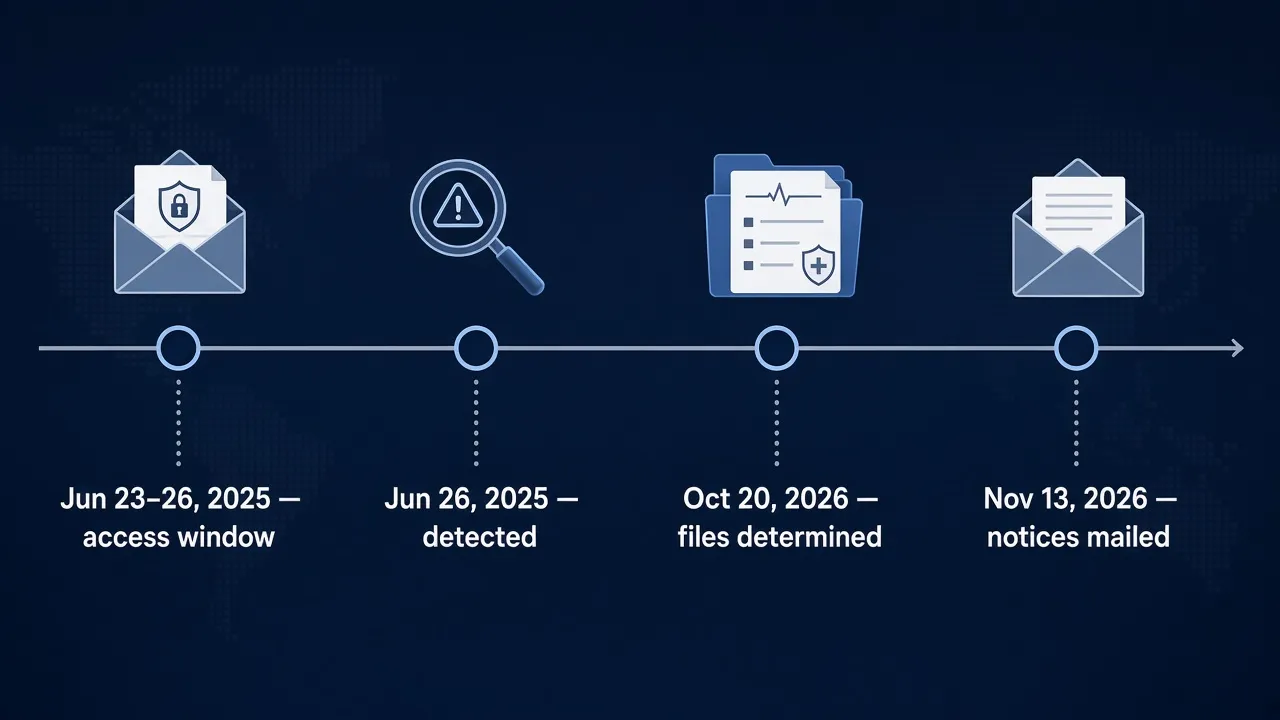
Yes — MPOWERHealth Holdings LLC disclosed a data security incident involving protected health information and other personal data maintained by the Addison, Texas–based healthcare company and its affiliates (HIPAA Journal describes musculoskeletal care solutions and value-based healthcare management; mpowerhealth.com markets intraoperative neuromonitoring (IONM) and surgical assist services). The company notice says unauthorized access to a limited portion of its internal network was detected on or about June 26, 2025, that a file review concluded on October 20, 2026 that impacted files may have contained personal information, and that individual notification began November 13, 2026.
The California Attorney General sample letter lists breach dates of June 23, 2025 and June 26, 2025 and matches the public notice narrative. The Texas OAG Data Security Breach Reports lists 88,200 affected Texans for MPOWERHealth Holdings LLC (BreachTally BR-0005525). BreachTally’s readout of that filing adds 1,831,295 individuals in total, discovery October 20, 2026 in AG metadata, U.S. Mail notice, and a Texas publication date of November 17, 2026.
This is a confirmed regulatory filing and published company notice — not a finished attribution story. The notice does not describe initial access method, ransomware, a leak site, or a named third-party vendor.
We tabulated the California listing in the November 13 California AG week roundup. This post is the standalone timeline, Texas count, vendor-readiness, phishing, website-tech, blacklist, lookalike, CourtListener, and MFA write-up for mpowerhealth.com.
Snapshot
| Field | Detail |
|---|---|
| Entity | MPOWERHealth Holdings LLC and affiliates (“MPOWERHealth”) |
| HQ | Addison, Texas (HIPAA Journal) |
| Official site | mpowerhealth.com |
| Texans affected (Texas OAG) | 88,200 · BR-0005525 · record published Nov 17, 2026 (BreachTally readout) |
| Total affected (BreachTally readout of BR-0005525) | 1,831,295 individuals |
| Massachusetts (BreachTally) | 25 residents · reported Nov 13, 2026 |
| California AG sample posted | Nov 13, 2026 (sb24-632869) |
| Consumer notice start (company) | Nov 13, 2026 (company notice) |
| Assistance line | (844) 301-0181 · Mon–Fri 9:00 a.m.–6:30 p.m. Eastern |
Data categories (company notice)
Per MPOWERHealth’s notice, elements varied by individual but included: first and last name, date of birth, Social Security number, driver’s license number, state/government ID, financial account information, medical information, and health insurance information.
HIPAA Journal summarizes the same categories and notes types may have included some or all of those fields depending on the person.
The Texas OAG entity type in the BreachTally readout is Healthcare – Medical Provider, with overlapping categories including address, SSN, driver’s license, financial, medical, health insurance, and date of birth (BR-0005525).
What MPOWERHealth says happened
From the company notice, the California AG sample PDF, and sb24-632869:
- June 23–26, 2025 — Unauthorized party accessed a limited portion of the internal network (CA sample lists both dates; company notice emphasizes detection ~June 26, 2025).
- October 20, 2026 — After investigation, MPOWERHealth determined impacted files may have contained personal information (including PHI under HIPAA).
- Starting November 13, 2026 — Individual notification in accordance with state and federal law.
The notice does not state whether data was encrypted at rest, whether files were exfiltrated, or whether a business associate caused the event.
Dates — compare sources before you quote one timeline
| Source | Key dates | Notes |
|---|---|---|
| Company notice | Detected ~Jun 26, 2025; PHI/file determination Oct 20, 2026; notify from Nov 13, 2026 | Primary resident-facing notice |
| California AG sb24-632869 | Breach Jun 23 & Jun 26, 2025; sample Nov 13, 2026 | CA does not publish affected counts |
| BreachTally BR-0005525 | Window Jun 23–26, 2025; discovered Oct 20, 2026; TX record Nov 17, 2026 | 509 days from breach-window end to TX record (per BreachTally); 88,200 TX (OAG) / 1,831,295 total (readout) |
| HIPAA Journal (Nov 16, 2026) | Same detection / Oct 20 / Nov 13 mail narrative | Notes no HHS OCR portal row yet and no CA population count |
Do not merge June 26, 2025 detection with October 20, 2026 file determination into a single “discovery” label without context. The October 20, 2026 field in BreachTally’s BR-0005525 readout is discovery metadata for that Texas record; the company’s June 26, 2025 language is detection of unauthorized access, not the completed data review.
Regulatory timing (informational, not a legal conclusion): From June 26, 2025 detection to November 13, 2026 mailed notice is roughly 16 months on the company’s own timeline. From October 20, 2026 determination to November 13, 2026 mail is 24 days. Whether any delay exceeded Texas (Tex. Bus. & Com. Code § 521.053) or HIPAA breach-notification clocks is not decided in public enforcement records we reviewed.
Why Texas clinics should care about notification lag and vendor posture
HIPAA Journal frames MPOWERHealth as a Texas-based musculoskeletal care and value-based healthcare management vendor. A 1.8 million–person mail notice with SSNs, medical, and insurance fields is a template for what can happen when internal network access intersects with centralized PHI.
For Texas medical practices and small businesses that exchange data with national healthcare vendors:
- Contract timing — Ask when a vendor must notify you of unauthorized access vs when it concludes a file review. The MPOWERHealth public story separates June 2025 access detection from October 2026 file determination.
- Downstream notice — If you hold duplicate PHI, your own Texas and HIPAA clocks may run from your knowledge of the event, not only from the vendor’s first press headline.
- Email and call impersonation — After mega-breach mail cycles, patients and staff receive bogus portal-reset and unsolicited “credit monitoring” messages that do not match the official letter. Type
mpowerhealth.comyourself; use (844) 301-0181 only with guidance from the mailed letter, not because an unexpected link or text told you to.
Email security and MFA checklist (practices and vendors)
| Step | Action |
|---|---|
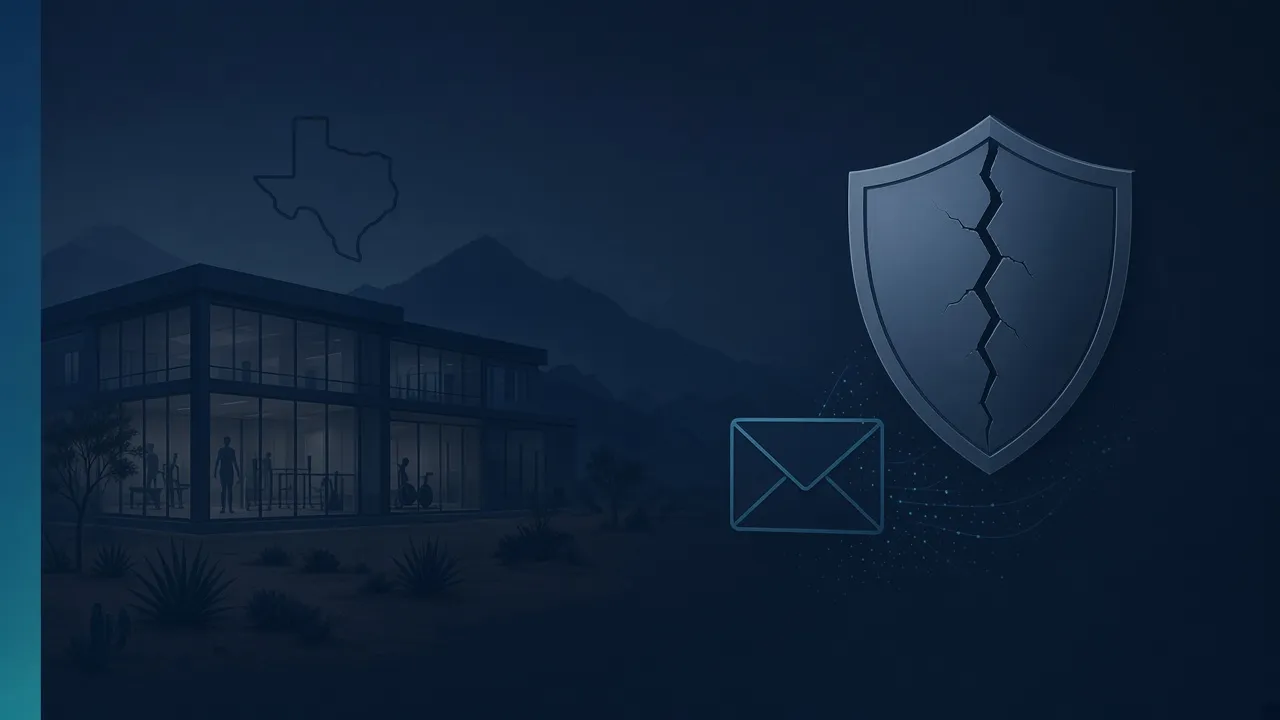
| 1 | Require FIDO2 / YubiKey or open TOTP on Microsoft 365 / Google Workspace admin roles — not SMS alone |
| 2 | Enforce DMARC reject + MTA-STS on domains that send patient or partner mail |
| 3 | Inventory business associates; document 72-hour (or tighter) incident notice clauses |
| 4 | Run lookalike monitoring before and after a vendor breach announcement |
| 5 | Train staff: no MFA codes over the phone; no gift-card “IT tests” |
MFA: YubiKey and Google Authenticator
| Grade | Meaning |
|---|---|
| Fail | SMS, email OTP, phone call, or no published YubiKey / open TOTP |
| Pass | Self-serve Google Authenticator-style open TOTP |
| Strong | FIDO2 / YubiKey-class security key for sign-in |
| N/A | No public login surface on this host |
| Unevaluated | Login host exists but MFA docs not public |
| Platform | Grade | YubiKey | Authenticator |
|---|---|---|---|
Public marketing / notice site (mpowerhealth.com) | N/A (no login) | N/A | N/A |
CT hosts portal., patientforms., scheduling.mpowerhealth.com | Unevaluated | Not public | Not public |
| Corporate mail (Microsoft 365 MX) | Unevaluated | Tenant policy not public | Tenant policy not public |
The marketing site and notice page have no public sign-in — there is nothing to grade for YubiKey or open TOTP on that host. Public CT logs show portal.mpowerhealth.com, patientforms.mpowerhealth.com, and scheduling.mpowerhealth.com certificates; we did not find public MFA enrollment documentation for those portals. MX points to Microsoft 365 (mpowerhealth-com.mail.protection.outlook.com), so workforce accounts are likely on Entra ID — where Microsoft documents FIDO2 security keys and authenticator apps. That is baseline guidance for similar tenants, not proof of MPOWERHealth’s live enrollment settings.
Texas practice baseline: Treat Microsoft 365 admin, EHR, and billing logins as Strong MFA targets before the next vendor incident in your supply chain.
Directory: MFA support directory · Texas healthcare breaches hub.
Recommended MFA tools
| Product | Best for | Get it |
|---|---|---|
| YubiKey 5C NFC | USB-C laptops + NFC phones | Amazon |
| YubiKey 5 NFC | USB-A desktops + NFC phones | Amazon |
| Proton Pass | Passkeys + authenticator-style TOTP | Proton Pass |
We may earn a commission if you buy a YubiKey or sign up for Proton Pass through the links above.
Independent cybersecurity audits
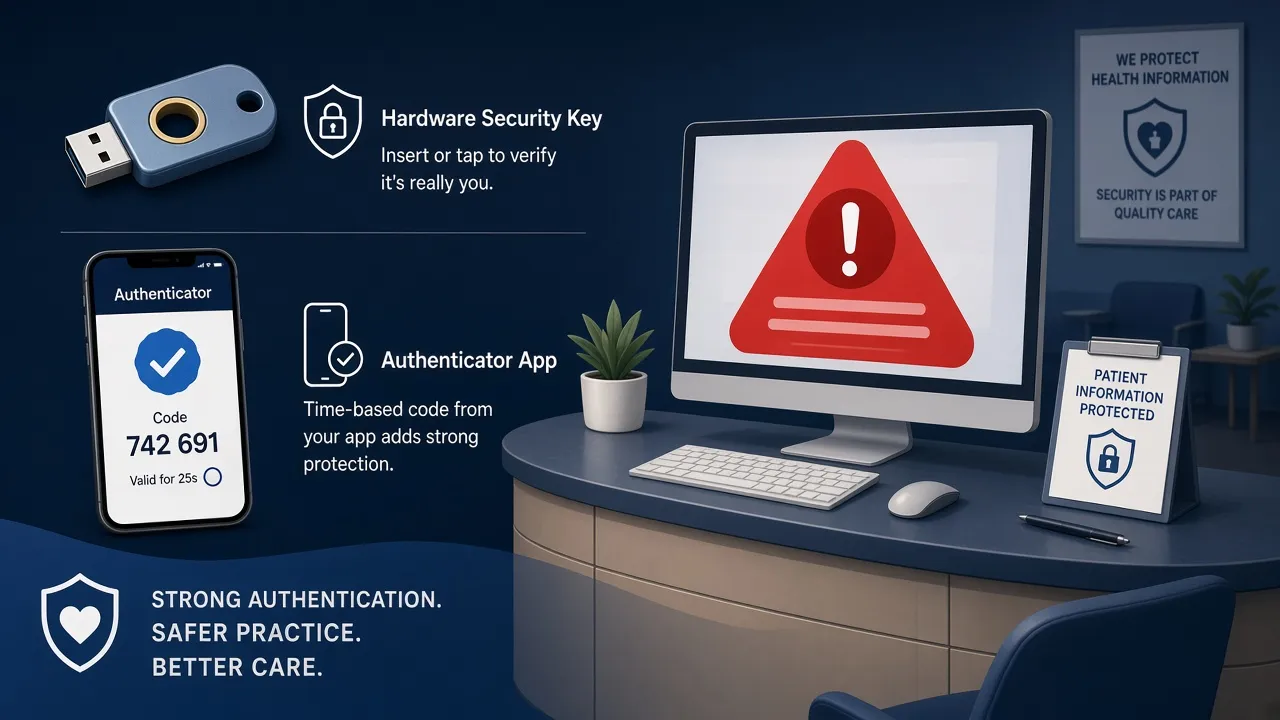
EmailMeNow audit run Nov 18, 2026 (read-only) on mpowerhealth.com — no public /?domain= URL and no POST /start. 100% is the ideal overall domain-security score. 0 of 1 scored hosts reach it.
| Organization | Domain | Overall | Gap vs 100% |
|---|---|---|---|
| MPOWERHealth (official) | mpowerhealth.com | 56% | −44 |
| Domain | Identity | Transport | Website |
|---|---|---|---|
| mpowerhealth.com | 70% | 15% | 37% |
How to read this: mpowerhealth.com at 56% with 15% transport matches the recurring MTA-STS enforcement gap — relevant when spoofed “MPOWERHealth monitoring” or “orthopedic records” mail circulates after a breach.
These scores measure public email authentication, transport policy, and website headers. They do not prove whether June 2025 files were copied or exfiltrated.
Clinics and vendors should still run a baseline check on the free domain security scan landing page (search the domain on the homepage — do not trust emailed ?domain= links). For managed review after an incident, see EmailMeNow services.
Website stack
Passive website-tech probe on November 18, 2026 (re-checked live headers the same day):
| Signal | Detail |
|---|---|
| Stack | WordPress · Hello Elementor theme · WP Engine (x-powered-by: WP Engine) · Cloudflare edge |
| HTTP → HTTPS | http://mpowerhealth.com returns 301 to https://mpowerhealth.com/ (live check) |
TLS — apex (mpowerhealth.com) | Let’s Encrypt · expires 2027-01-25 (live handshake) |
| TLS — wildcard (CT) | *.mpowerhealth.com · DigiCert · expires 2027-03-02 (CT logs) |
Live headers checked November 18, 2026.
Point-in-time only — public marketing stack is not proof that clinical or billing systems match this footprint.
Blacklist and lookalikes
Email blacklist (public DoH, November 18, 2026): mpowerhealth.com clear (0 mail/domain hits on checked lists). SPFBL notes on shared web/CDN IPs are provider noise — not led here.
DNS lookalike scans on mpowerhealth.com (14 registered string variants; 0 BEC staging with MX-without-A):
| Profile | To review | BEC staging | Note |
|---|---|---|---|
| Standard | 14 | 0 | impowerhealth.com — insertion-variant string, but an unrelated clinic brand (Mobics, Woodbridge, Ontario) |
| BEC | 14 | 0 | Same candidate set |
Other registered strings include powerhealth.com (omission, Google Workspace MX), m-powerhealth.com, and TLD swaps (mpowerhealth.net, .org, etc.). They may belong to unrelated businesses; we did not evaluate them. Patients should treat any non-official host as unverified unless MPOWERHealth explicitly confirms ownership.
Continuous monitoring: Cybersquat Domain Monitoring.
CourtListener
CourtListener REST search on November 18, 2026 for “MPOWERHealth” and data breach returned no breach class action naming MPOWERHealth tied to the November 2026 AG filings (unrelated name matches only). HIPAA Journal also notes the incident had not appeared on the HHS OCR breach portal at publication time — check OCR for updates before treating a federal HIPAA posting as missing.
What affected individuals and Texas practices should do now
- Read the official notice and your mailed letter. Call (844) 301-0181 only with that letter in hand.
- If the California AG sample letter matches what you received, activate complimentary Kroll identity monitoring at enroll.krollmonitoring.com using the Membership Number printed on your letter (activate by the deadline in your letter).
- Watch explanation-of-benefits, credit reports, and medical bills for unfamiliar activity — SSN plus insurance data supports medical identity theft and tailored phishing.
- Be wary of unsolicited “MPOWERHealth monitoring” or portal links that do not match your letter (wrong URL, no membership number, or pressure to pay). Legitimate Kroll enrollment uses
enroll.krollmonitoring.complus the mailed code — not a random.netor.colookalike. - Practice owners: re-read business associate agreements for incident notice deadlines; require Strong MFA on admin roles that receive vendor security mail.
- Report phishing to the FBI IC3 and the Texas Attorney General.
Related coverage
- California AG breaches — week of Nov 13, 2026
- Healthcare AG breach tracker
- Texas healthcare breaches hub
- Texas OAG YTD dashboard
- Access Dental DSO breach (Nov 2026) — same Texas mail-notice week, different sector scale
Sources: MPOWERHealth notice · California AG sb24-632869 · California AG sample PDF · Texas OAG Data Security Breach Reports · BreachTally BR-0005525 · HIPAA Journal (Nov 16, 2026). Independent EmailMeNow audit, website-tech, blacklist, cybersquat, and CourtListener work November 18, 2026.