Most consumer air quality monitors still document 2.4 GHz Wi-Fi and WPA/WPA2 — or they stay on Bluetooth and Thread with no Wi-Fi radio at all. The uHoo Caeli is different on paper: uHoo’s product page and technical specification PDF list Wi-Fi 6 (802.11ax) on dual-band 2.4 GHz and 5 GHz with WPA3-Personal (WPA/WPA2 backward-compatible). The older uHoo Smart Air Monitor does not — it remains Wi-Fi 4, 2.4 GHz only, and WPA/WPA2 per uHoo’s SAM tech specs and comparison table.
Last checked: November 16, 2026. We verified wireless fields from vendor-published specs only — not forum posts or retail copy. When a vendor does not publish WPA mode, we label it Not published.
This is a Wi-Fi and account-security explainer, not a product review and not a ranking of sensor accuracy.
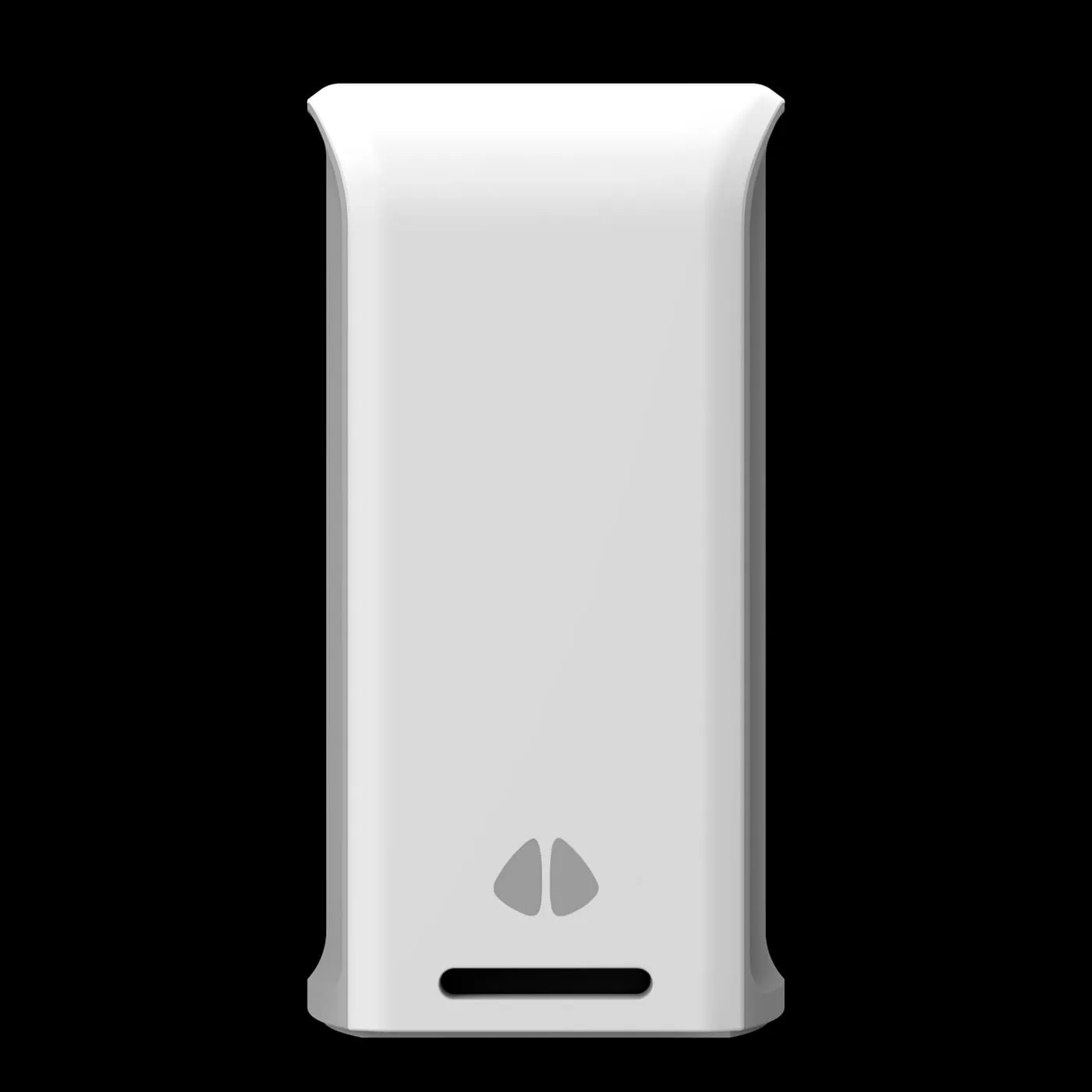
Image: uHoo Caeli — manufacturer product photo via uHoo’s official Shopify store.
Snapshot
| Field | Detail |
|---|---|
| Model verified | uHoo Caeli (current flagship Wi-Fi monitor) |
| Wi-Fi (uHoo docs) | 802.11ax (Wi-Fi 6) · 2.4 & 5 GHz · WPA3-Personal (WPA/WPA2 fallback) |
| Legacy contrast | uHoo Smart Air Monitor — 802.11n, 2.4 GHz, WPA/WPA2 (no 5 GHz) |
| FCC filings | uHoo Pte. Ltd. holds FCC grantee code 2BV4V (EAS registration, received 2026-05-14); no Caeli radio grant indexed on FCCID.io as of this check — rely on uHoo’s FCC certification line in specs |
| Competitor takeaway | Among Wi-Fi home monitors we could verify, only Caeli documents both 5 GHz and WPA3; Qingping Air Monitor Gen 2 documents 5 GHz but not WPA3 |
| Domain audits (Nov 16, 2026) | uhooair.com 36% · getuhoo.com 42% · 100% is the ideal overall score |
| uHoo account MFA | No published Google Authenticator / open TOTP or YubiKey/FIDO2 enrollment — password + email account only |
Why WPA3 and 5 GHz matter on an air monitor
| Topic | Practical meaning for owners |
|---|---|
| WPA3-SAE | Replaces WPA2’s 4-way handshake with Simultaneous Authentication of Equals (SAE), which blocks offline password guessing against captured handshakes and adds forward secrecy for the Wi-Fi session. |
| PMF (802.11w) | WPA3-Personal requires protected management frames, which blunts classic deauthentication (“Wi-Fi jammer”) attacks that knock IoT devices offline on WPA2 without PMF. |
| 5 GHz (with Wi-Fi 6) | Lets the monitor join a dedicated IoT SSID on 5 GHz while phones stay on 2.4 GHz — less congestion and easier VLAN segmentation on modern routers. |
| Cloud path | Like most IoT air gear, Caeli still phones home over TLS once on Wi-Fi; router Wi-Fi mode does not replace strong account passwords or firmware updates. |
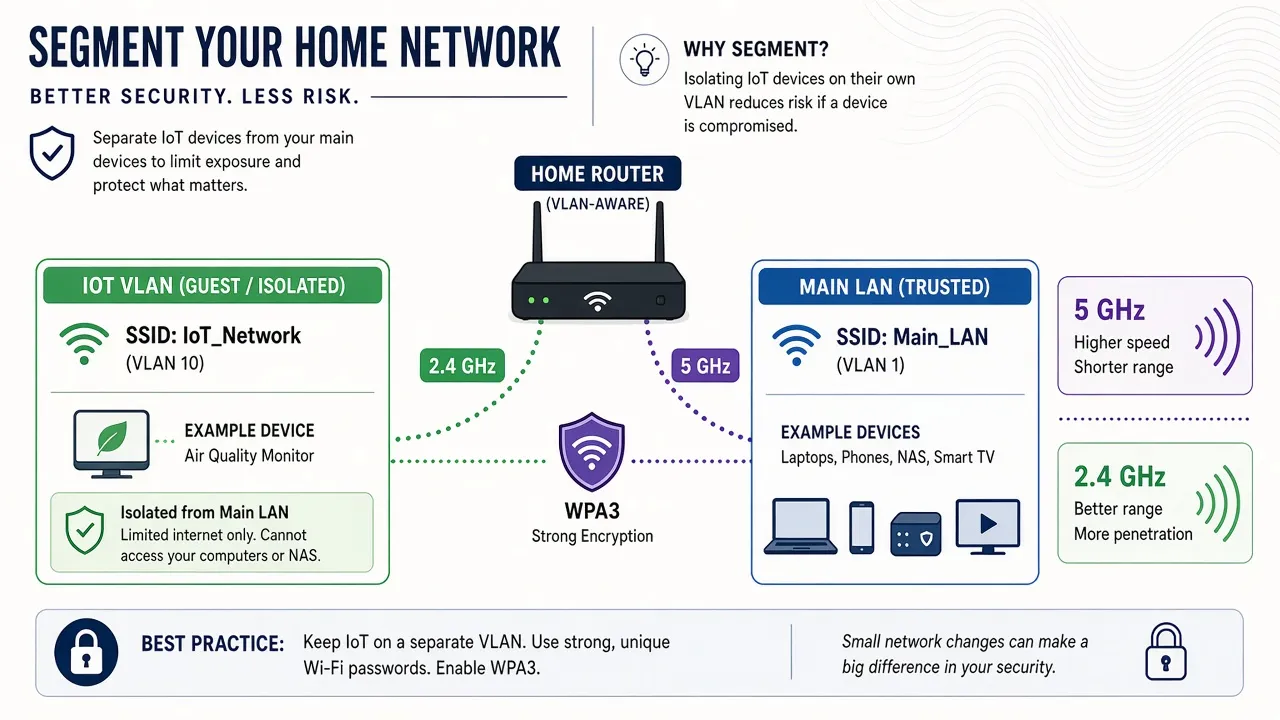
Illustration: segmentation concept — not a uHoo network diagram.
Wi-Fi security risks: WEP through WPA3
The product tables in this post describe what each vendor publishes about its gear. Separately, every owner should understand how legacy Wi-Fi security modes fail in the real world. Attacks differ: some require capturing traffic and offline guessing; others require only radio range and affect availability — not decryption.
WEP and WPA (TKIP)
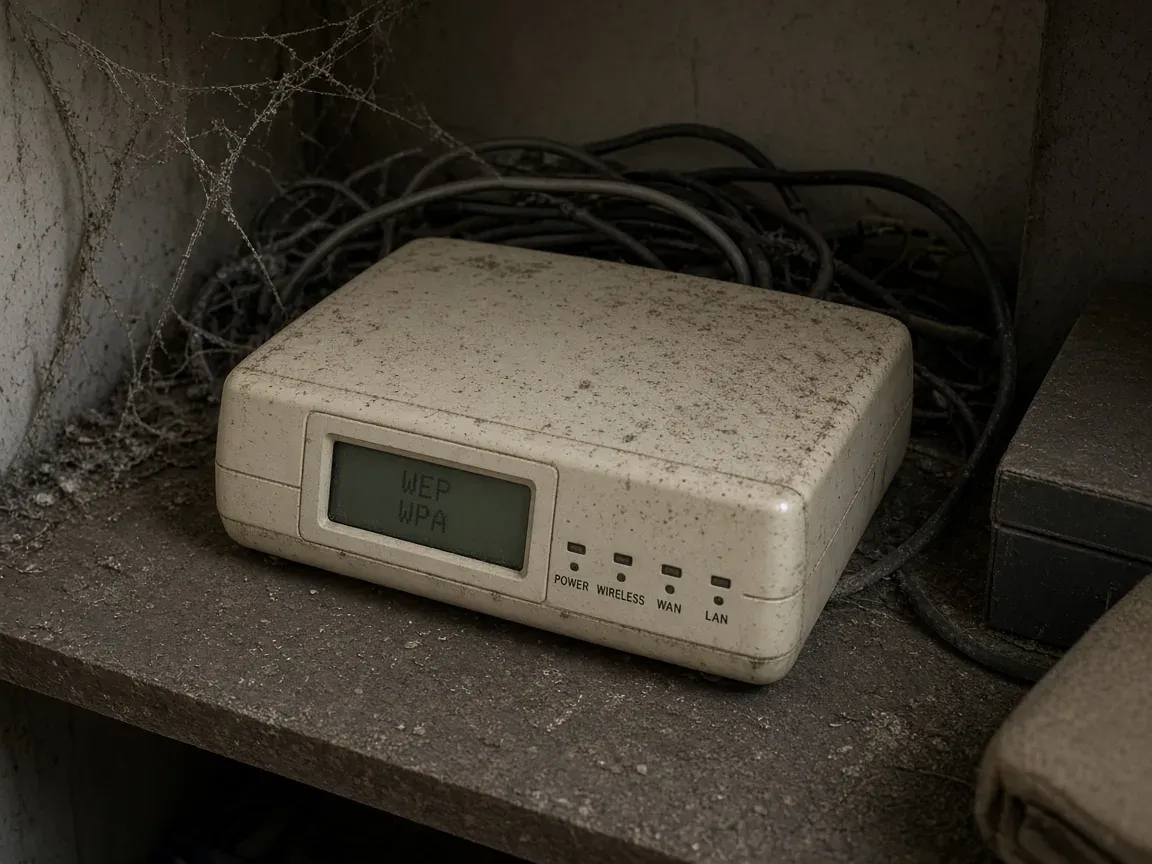
WEP (Wired Equivalent Privacy) was broken years ago: passive capture plus commodity tools can recover a WEP key in minutes on busy networks. The Wi-Fi Alliance and industry guidance treat WEP as obsolete — do not operate IoT or cameras on WEP. WPA with TKIP replaced WEP but is also deprecated; modern certification programs expect AES (CCMP) and WPA2 or WPA3.
WPA2-Personal (PSK)
WPA2-PSK is still common on routers and IoT SSIDs. Its weaknesses are well documented:
- Offline passphrase attacks. An attacker who records a valid 4-way handshake or a router PMKID (where the AP exposes it) can attempt offline dictionary attacks against the passphrase. Short or reused passwords fall quickly; a long, random passphrase makes offline guessing impractical in practice. This is realistic on WPA2-PSK when the password is weak — not when the passphrase is strong.
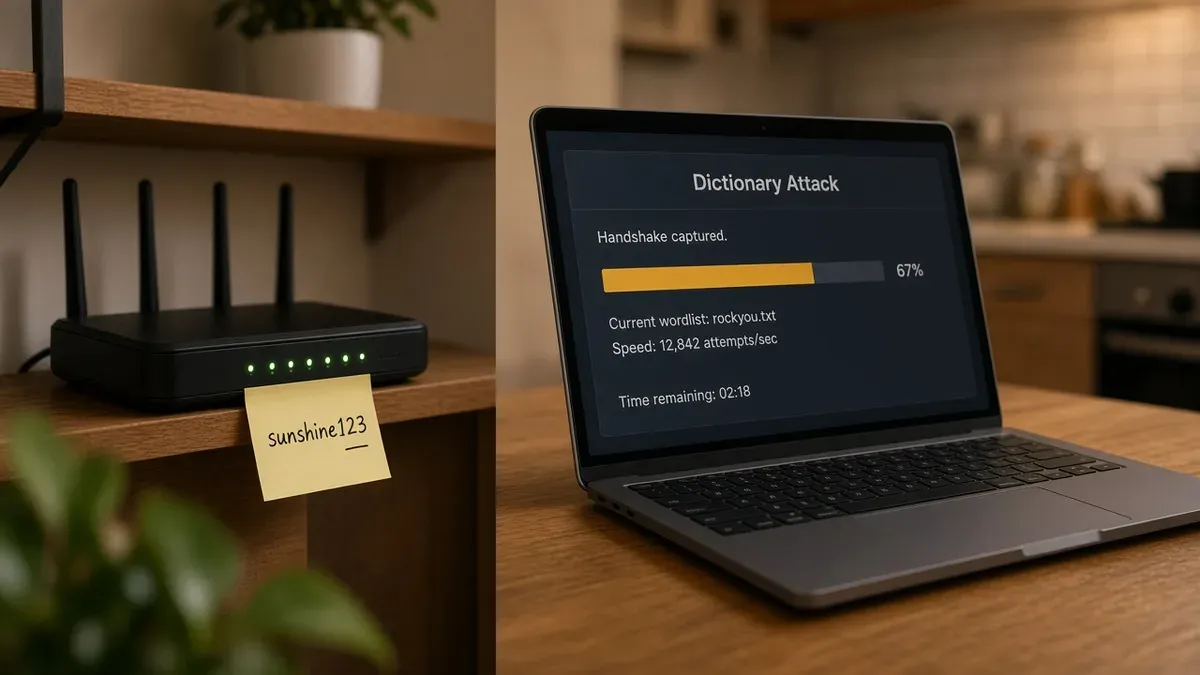
Illustration: a captured handshake plus a guessable passphrase — not a substitute for router sticker photos in real incidents. - Neighbors or guests on your PSK. Anyone with the Wi-Fi password can join the LAN like a trusted device. That often means their traffic exits through your public IP address, which can complicate abuse complaints or law-enforcement inquiries. Segment IoT and rotate the passphrase if you suspect sharing — see NIST WLAN guidance below.
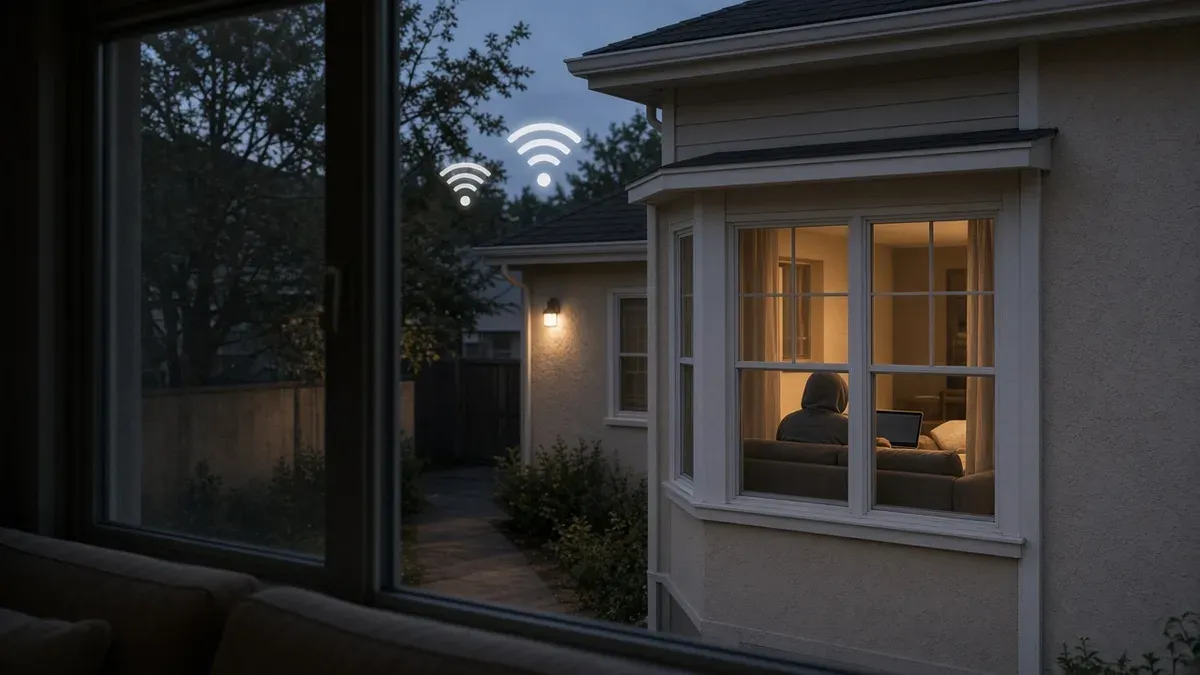
Shared passwords are convenient; they also mean your IP can carry someone else’s activity. - On-LAN reach to your devices. Joining the Wi-Fi does not automatically grant control of every camera, oven, or laptop. It does place an attacker on the same broadcast domain, where they can probe for unpatched firmware, default credentials, and unencrypted local traffic. VLANs, guest networks, and device updates reduce that exposure.
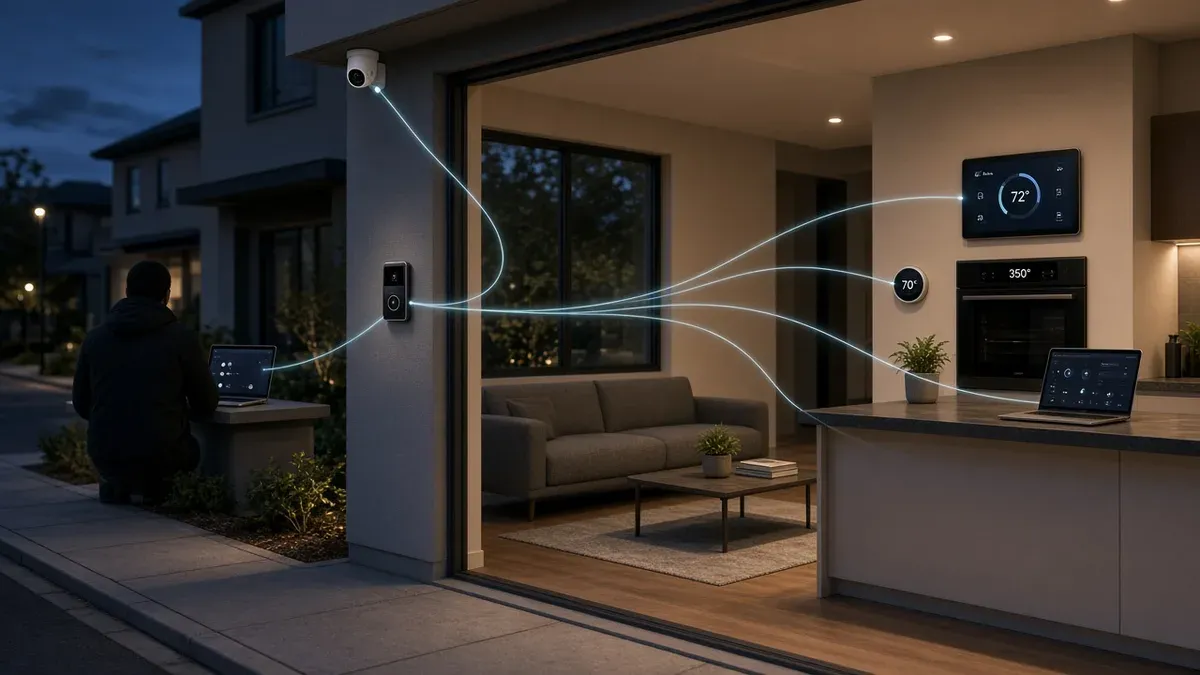
Being on the LAN enables probing and targeted attacks — not instant ownership of every gadget. - KRACK (2017). Research by Mathy Vanhoef showed that some WPA2 implementations could reinstall encryption keys during the handshake, enabling traffic manipulation or decryption on unpatched clients. Most vendors shipped fixes in 2017–2018, but forgotten IoT firmware may still have unpatched firmware. KRACK requires proximity; it is not the same as guessing a weak password. Primary reference: krackattacks.com · CERT VU#228519.
- No forward secrecy on PSK networks. With WPA2-Personal, anyone who knows the passphrase and has stored ciphertext can decrypt those captured frames later. WPA3-Personal (SAE) adds forward secrecy for sessions after pairing — see Wi-Fi Alliance WPA3 materials.
- Deauthentication and disassociation. Classic management frames can knock a client offline when Protected Management Frames (802.11w / PMF) are not enforced. That is an availability attack: it does not by itself decrypt video or credentials, but it can blind a camera or doorbell until it reconnects — the scenario behind many “Wi-Fi jammer” thefts. PMF and WPA3 are the practical mitigations on supported gear.
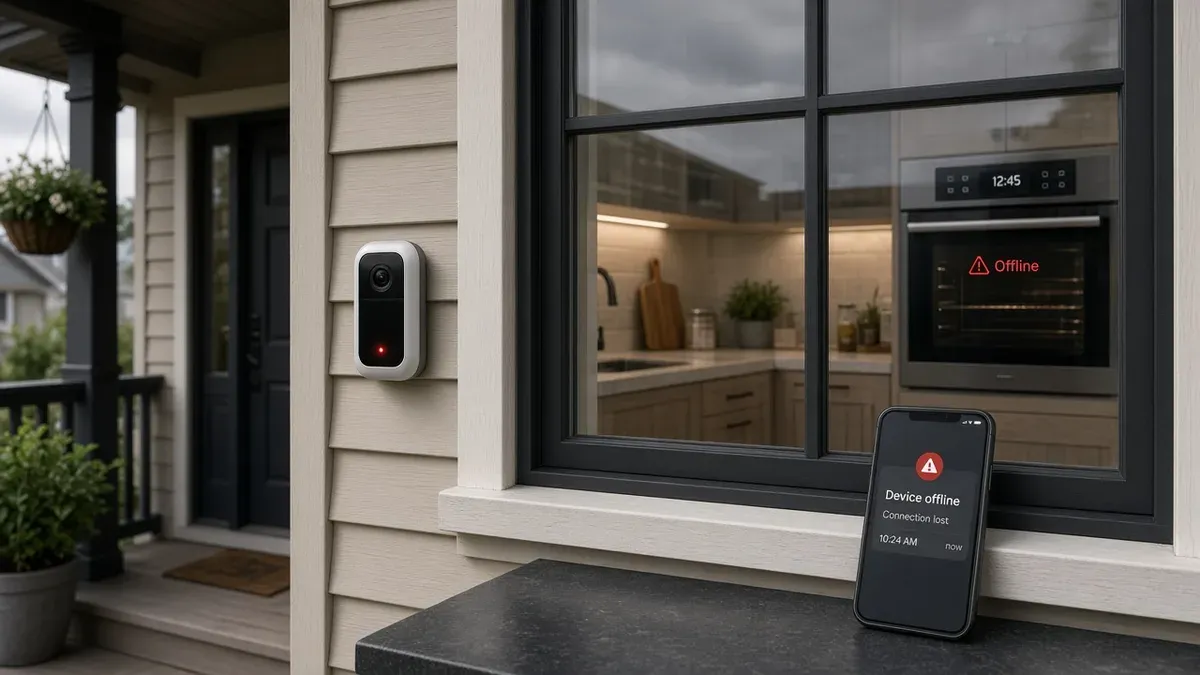
Deauth affects availability — devices may show offline even though the passphrase was never cracked. - Evil twin / rogue access points. A nearby attacker can broadcast a convincing SSID and capture credentials or push a captive portal. Mitigations include verifying router settings, using unique SSIDs, and segmenting IoT — see NIST wireless LAN guidance below.
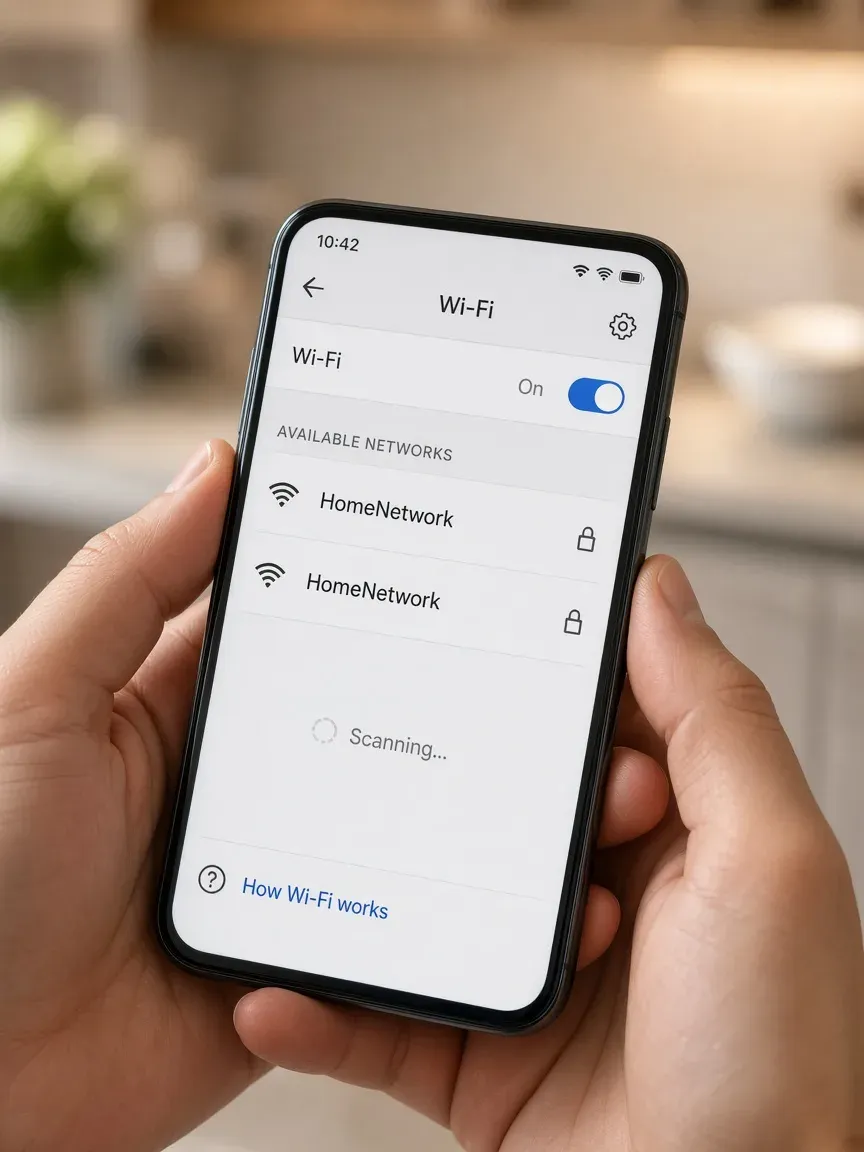
Two similar names on a phone — always confirm which AP is yours before joining.
WPA3-Personal and Enterprise
WPA3-Personal uses SAE (Simultaneous Authentication of Equals), which greatly improves resistance to offline guessing compared with WPA2’s 4-way handshake, and mandates PMF for certified WPA3 gear. Wi-Fi Alliance overview: Wi-Fi Alliance — Security · WPA3 announcement.
Dragonblood (2019). Follow-on research found implementation flaws in early WPA3 / SAE stacks (downgrade and side-channel classes). Vendors patched affected firmware; owners should still install router and IoT updates. Primary reference: Dragonblood (Vanhoef & Ronen).
What owners can do
| Priority | Action | Why it matters |
|---|---|---|
| 1 | Use a long random passphrase (or WPA3-SAE where supported) | Reduces offline PSK cracking if a handshake is ever captured |
| 2 | Install router and device firmware updates | Closes KRACK-class bugs and Dragonblood-era implementation flaws |
| 3 | Enable PMF (802.11w) — capable or required on the AP when clients allow | Hardens against forged deauth/disassoc on many WPA2 networks; mandatory under WPA3 |
| 4 | Segment IoT on a dedicated VLAN or guest SSID with firewall rules | Limits lateral movement if one gadget is compromised |
| 5 | Prefer WPA3 or WPA2/WPA3 transition only when every client supports it | Avoid WPA3-only SSIDs that brick older 2.4 GHz IoT until vendors document support |
Primary sources (verified Oct 20, 2026)
| Topic | Reference |
|---|---|
| WEP obsolescence | Wi-Fi Alliance — Security (WEP not permitted under current programs) |
| KRACK / WPA2 handshake | krackattacks.com · CERT VU#228519 |
| WPA3, SAE, PMF | Wi-Fi Alliance Security |
| Dragonblood (WPA3 implementation) | wpa3.mathyvanhoef.com |
| Wireless LAN security (rogue AP, segmentation, unauthorized access) | NIST WLAN guidelines (SP 800-153) |
| Protected Management Frames (802.11w) | IEEE 802.11w amendment; summarized in Wi-Fi Alliance security materials above |
Risk illustrations above are AI-generated scenes for education (not incident photos). Related: WPA3 upgrade checklist · Guest / IoT Wi-Fi isolation.
uHoo models — what the vendor publishes
| Model | Wi-Fi generation | Bands | WPA (vendor docs) | Source |
|---|---|---|---|---|
| uHoo Caeli | Wi-Fi 6 (802.11ax) | 2.4 & 5 GHz | WPA3-Personal (WPA/WPA2 compatible) | Caeli specs PDF · product page · FAQ |
| uHoo Smart Air Monitor | Wi-Fi 4 (802.11n) | 2.4 GHz only | WPA/WPA2 | SAM specs PDF · comparison |
uHoo’s legacy Wi-Fi setup article still describes 2.4 GHz only behavior for the original Smart Air Monitor (recommend splitting SSIDs on dual-band routers). Do not assume that article applies to Caeli — Caeli’s FAQ explicitly allows 802.11ax at 2.4 and/or 5 GHz with WPA/WPA2/WPA3-Personal.
FCC note: uHoo lists FCC among Caeli certifications, but we did not find a model-specific FCC ID grant package for Caeli on FCCID.io under grantee 2BV4V at publish time. Treat vendor PDFs as the primary wireless source until a public grant appears.
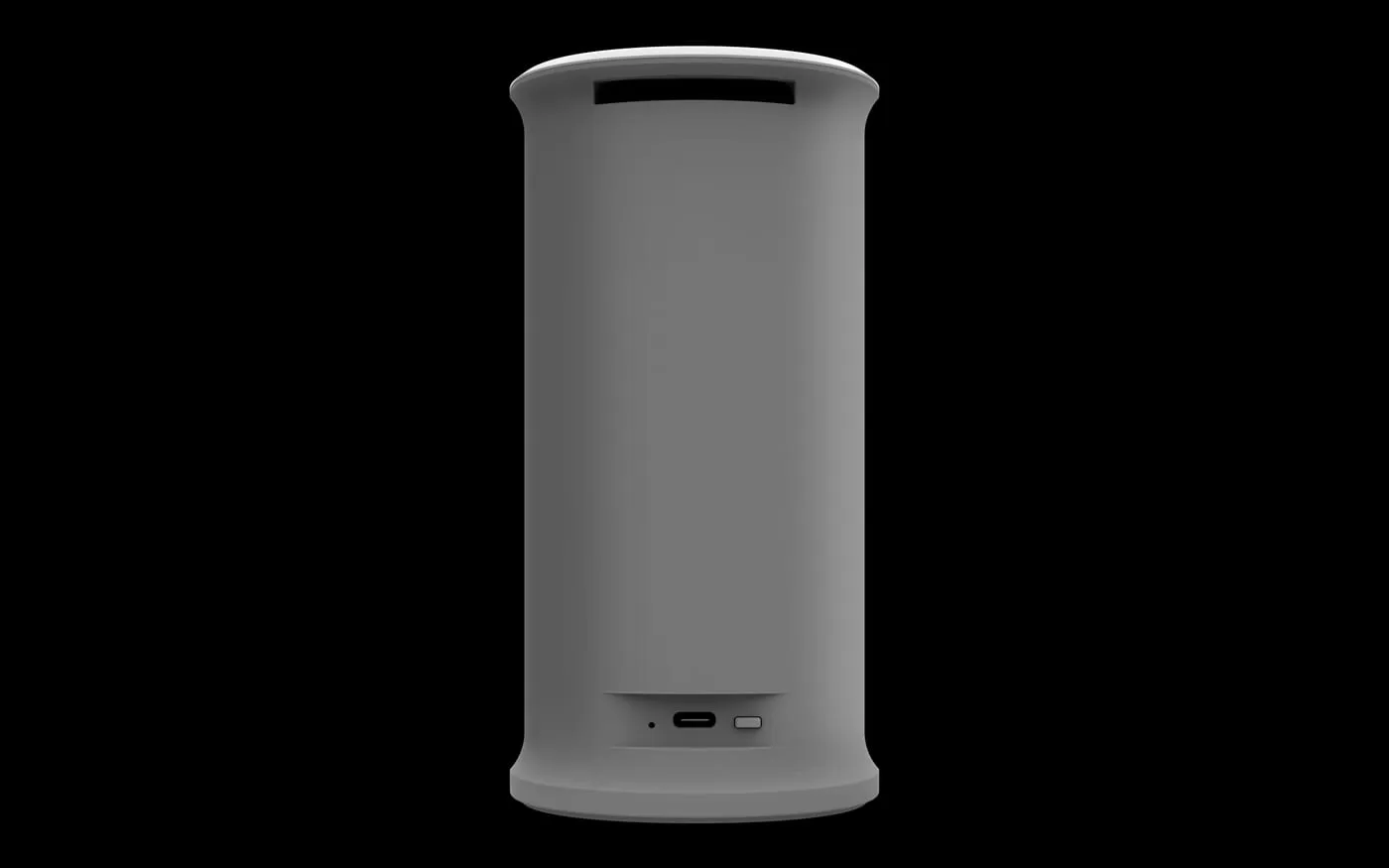
Image: uHoo Caeli — manufacturer product photo via uHoo’s official Shopify store.
Competitor Wi-Fi — verified consumer monitors
We compared official specs or support articles for common home monitors. Not published means the vendor did not state WPA3 in the source we used — not a lab test.
| Model | Wi-Fi band | WPA3 (vendor docs) | Source |
|---|---|---|---|
| uHoo Caeli | 2.4 & 5 GHz (802.11ax) | Yes (WPA3-Personal) | uHoo Caeli PDF |
| Qingping Air Monitor Gen 2 | 2.4 & 5 GHz (802.11a/b/g/n/ac/ax) | Not published | Qingping product page |
| Airthings View Plus | 2.4 GHz only (802.11 b/g/n) | No — docs say avoid WPA3-only SSIDs | Product sheet PDF · Wi-Fi help |
| Awair Element | 2.4 GHz only | Not published (WPA, WPA2) | Connectivity specs |
| Amazon Smart Air Quality Monitor | 2.4 GHz only | Not published | Amazon product technical details |
| Netatmo Smart Indoor Air Quality Monitor | 2.4 GHz only (no 5 GHz) | No (Open/WEP/WPA/WPA2-personal) | Netatmo help |
| IQAir AirVisual Pro | 2.4 GHz only | Not published (WPA/WPA2 on dealer spec) | AVP technical specifications PDF |
| Kaiterra Laser Egg | 2.4 GHz only | No — support says turn off WPA3, use WPA2 | iOS Wi-Fi setup |
| Aranet4 HOME | No Wi-Fi (Bluetooth) | N/A | Aranet4 uses BLE — out of scope for WPA3 |
| Eve Room (Thread) | No Wi-Fi (Thread) | N/A | Thread/Matter — different radio |
Claim discipline: Mark asked whether Caeli is “one of the few” home monitors with both WPA3 and 5 GHz. After the table above, we narrowed that to: among Wi-Fi consumer air monitors we could verify from official docs, only uHoo Caeli documents WPA3-Personal together with 5 GHz. Qingping Gen 2 is a partial match (5 GHz yes, WPA3 not published). Most others are 2.4 GHz–only and WPA2-class.
What to do on your router
| Step | Action |
|---|---|
| 1 | Create an IoT SSID (or VLAN) for sensors; use WPA3-Personal or WPA2/WPA3 transition with PMF required when the router allows it |
| 2 | Prefer 5 GHz for Caeli if your router exposes a dedicated IoT radio; keep 2.4 GHz available for legacy monitors on the same VLAN policy |
| 3 | Block east-west traffic from IoT to laptops, NAS, and printers (client isolation + firewall rules) |
| 4 | Disable UPnP and review port forwards — uHoo’s legacy article mentions outbound 80, 443, and 8466 |
| 5 | Patch router firmware and enable auto updates on the uHoo app when offered |
Related reading: WPA3 upgrade checklist · Devices that block WPA3-only rollouts · Guest Wi-Fi isolation · Wyze Wi-Fi lineup baseline.
uHoo account security (separate from WPA3)
Wi-Fi WPA3 protects the radio link. It does not stop credential stuffing against uhooair.com logins.
| Control | uHoo public docs |
|---|---|
| Password | Yes — “strong password” required in Terms of Use |
| SMS / email OTP at login | Not published as account 2FA |
| Google Authenticator / open TOTP | Not published |
| YubiKey / FIDO2 | Not published |
| Passkeys | Not published |
Under our MFA directory rules, uHoo’s published account model grades Fail until uHoo documents enrollable app TOTP, passkeys, or security keys — same framing we use for IoT vendors in Ring’s 2FA explainer.
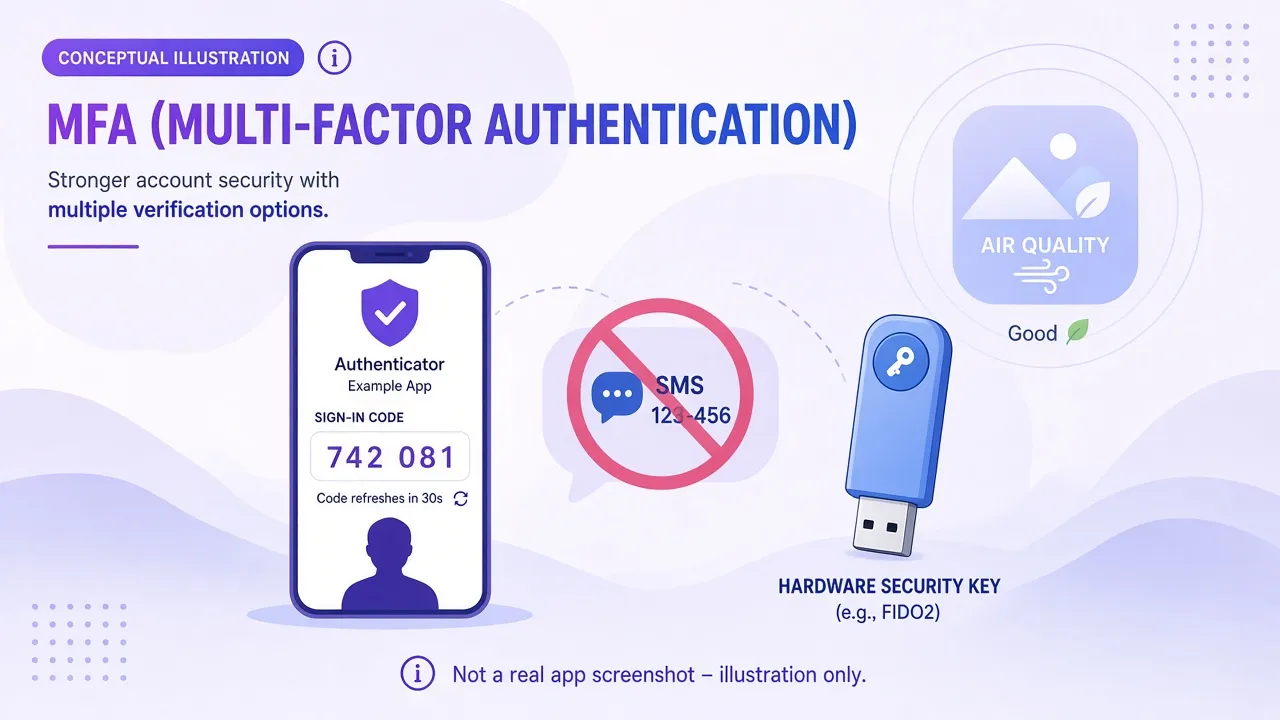
Illustration only — not a uHoo app screenshot.
Domain security audits
Overall domain compliance scores below assume 100% is ideal (identity, transport, infrastructure, website, endpoint). Scores are from cached admin audit data (November 16, 2026).
| Domain | Overall | Identity | Transport | Email infra | Website | Endpoint |
|---|---|---|---|---|---|---|
| uhooair.com | 36% | 10% | 15% | 100% | 37% | 75% |
| getuhoo.com | 42% | 25% | 15% | 100% | 37% | 75% |
| airthings.com | 78% | 75% | 15% | 100% | 90% | 75% |
| awairhome.com | 29% | 0% | 15% | 30% | 40% | 75% |
| netatmo.com | 76% | 70% | 15% | 100% | 92% | 75% |
| iqair.com | 52% | 50% | 15% | 100% | 37% | 75% |
| kaiterra.com | 68% | 70% | 15% | 100% | 65% | 75% |
| qingpingiot.com | 28% | 0% | 15% | 30% | 37% | 75% |
uhooair.com at 36% with 10% identity is a reminder that password-reset and account-alert email is its own attack surface — even when the device radio supports WPA3. getuhoo.com at 42% is the marketing storefront lane.
Website stack note
Passive website-tech probes (November 16, 2026):
| Domain | Stack signal |
|---|---|
| uhooair.com | Undetected CMS fingerprint |
| getuhoo.com | Undetected; sampled TLS valid (Let’s Encrypt); plain HTTP success without HTTPS redirect on probed host |
| airthings.com | Undetected; TLS valid (Amazon Trust Services) |
| netatmo.com | Nuxt; freshness detected_no_version |
| kaiterra.com | HubSpot; jQuery 1.7.1 CVE hint (upgrade client-side libraries on marketing pages) |
| qingpingiot.com | Undetected; plain HTTP success without HTTPS redirect on probed host |
Blacklist and lookalikes
Email blacklist (public DoH, November 16, 2026): uhooair.com and getuhoo.com were clear on mail/domain lists we query. Informational SPFBL hits on web/CDN IPs are not mail reputation.
DNS lookalike scan (standard profile):
| Brand scanned | To review | BEC staging | Notable |
|---|---|---|---|
| uhooair.com | 2 | 1 | hooair.com (omission) flagged BEC staging |
| getuhoo.com | 3 | 0 | gethoo.com, getunoo.com registered |
Pair periodic scans with Cybersquat Domain Monitoring. Type getuhoo.com / uhooair.com yourself — do not trust redirect links in unsolicited mail.
CourtListener: We did not run RECAP litigation search — no breach notice or federal docket was in scope for this product-spec piece.
Check your domain free at audit.emailmenow.com, or see automated reports and monitoring.
Sources: uHoo Caeli · uHoo Caeli store listing · Caeli tech specs PDF · Caeli user manual PDF · uHoo Smart Air Monitor comparison · SAM specs PDF · competitor links in table above. Independent EmailMeNow admin-cached domain audits, website-tech, blacklist, and cybersquat scans November 16, 2026. Official product links only — no affiliate links. Product photos are uHoo’s official Shopify listing images (credited in captions). Segmentation and MFA figures are generated illustrations, not uHoo photography.